Lê Hoàng Việt
  • Home
  • Literature Review and Analysis
  • Cartography
  • Armor Blog
  • Discourse
  • Essays
  • Home
  • Literature Review and Analysis
  • Cartography
  • Armor Blog
  • Discourse
  • Essays
Search by typing & pressing enter

YOUR CART

ARMS AND ARMORS

1/28/2020 0 Comments

14th century Hourglass gauntlet
Picture
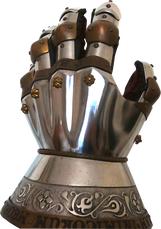
A mordern reproduction hourglass gauntlet.

Introduction

In melee combat, it is the hands that ensure the knight on the offensive. If the hands are injured, it leaves the knight at the mercy of the enemy regardless to the quality of the breastplates or helmet. Thus, some form of hand protection is important.

Nevertheless, it was a dilemma for armorers. Any type of hand defense needed to have adequate protection without interfering the use of the hand in wielding weapon. 

Until the 12th century, there was virtually no hand armor. Afterwards, mail (chain mail) was used to create hand armor. In the transitional period of the 14th century, hourglass gauntlet was the dominant form of hand armor.
Picture
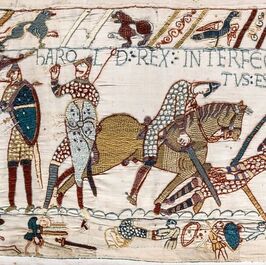
There was no hand protection before the 12th century.

Early Form of hand protection: Mail

In the 11th century, knight wore a hauberk (knee-length mail shirt) and a gambeson (aketon, doublet) underneath to protect his arm up to the fore arms, according to the Bayeux Tapestry. The protection to the hand,  which was not mentioned in any literature in this period, was exceptionally rare.  A knights had to relied mainly on shield and weapon's guard to protect his hands. Some observations suggest he might wore leather or padded cloth gloves for defense as these had existed few centuries in Europe.
 
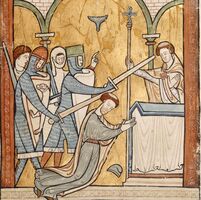
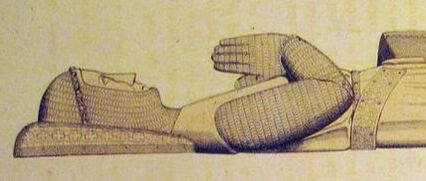
In the late 12th century, mail mittens rose to popularity as the sleeves of the hauberk extended from the elbow until it protect the entire hands. All of the fingers are in a single pouch with a separate compartment for the thumb. The padded cloth or leather palm was slitted, allowing the wearer to removed the mitten without removing the hauberk. 

Mail offered excellent protection against stab and slash weapon. And because of its flexibility, mail mitten did not hinder fighting capability much. 
Picture
Mail mitten on soldiers' hands. The Death of Saint Thomas Becket in Canterbury Cathedral. Late 12th century.
Picture
Mittens could be taken off without removing the hauberk. 19th century sketch of the brass of Sir Robbert De Septvans (14th century)
In late 13th century, mail mittens became an independent piece of armor called mail gauntlets. In the Effigy of William de Valance, mail gauntlets separated from the hauberk. They protected individual finger; and by giving the wearers the full movement of the wrist, they increased precision and control of weapon. The sketch of the 14th century mail mitten in an effigy in Church of Schutz show the similarity of the mail mitten to our modern glove. It also suggests that knight wore a pair of leather gloves underneath or sometime above mail gauntlets. 
Picture
Effigy of William de Valence, 1298. 19th century sketch.
Picture
Sketch of Mail mitten of the 14th century, based on an effigy of a knight in the Church of Schutz, Alsace

Hour-Glass Gauntlets

In the period of transition in the 14th century, the introduction of plate armors encouraged a new improvement in gauntlets that would remain in the mainstream for the next 100 years. Plate gauntlets were masterfully crafted in such a way that even fit the wearers' hands perfectly down to individual fingers. These new gauntlet were known as hourglass gauntlet because of its hour-glass shape.

There are two variants of the hourglass gauntlets: the demi-gauntlet and the fingered gauntlet

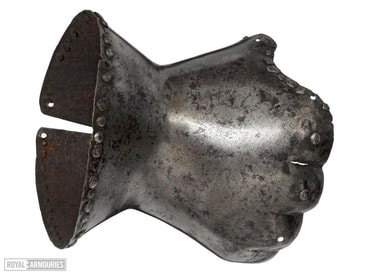
The demi-gauntlet type is the lighter type of the two. It protects from the wrist to the back of the palm. A mail gauntlet or padded glove is used to the protects the palm and fingers. ​
​
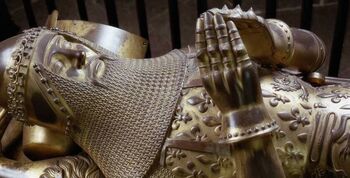
​The fingered-gauntlet is the most sophisticated gauntlet of its time. It protects the wrist and the entire back of the hand with many steel plates. These plates are carefully measured to perfectly fit individual fingers without restricting their movement in combat. A glove made of leather or padded cloth attached to the inside of fingered-gauntlet by rivets.

The shift from mail gauntlets to hourglass gauntlets was mainly due to better protection. The main advantage of plate armor over mail armor is that its hardness provide much better protection against crush attack. The hourglass gauntlet can reduce and deflect heavy blows from blunt weapons while the flexible mail gauntlet is much vulnerable against them.


Picture
Italian demi-hourglass gauntlet (1371-1399). Royal Armories.
Picture
A pair of fingered hourglass gauntlet. Effigy of Edward the Black Prince. 1376
0 Comments


Leave a Reply.

    Viet Le

    This section is dedicate to the understanding of armor.

Proudly powered by Weebly